In the previous chapters, we laid the groundwork for probability, exploring sample spaces, events, and counting techniques. Now, we venture into one of the most fundamental and powerful concepts in probability theory: conditional probability.
Often, we are interested in the probability of an event occurring given that another event has already happened. Our knowledge or assumptions about one event can change our assessment of the probability of another. This is the essence of conditional probability. It allows us to update our beliefs in the face of new information.
Conditional Probability measures the probability of an event A occurring given that another event B has already occurred (or is known to have occurred). We denote this as P(A∣B), read as “the probability of A given B”.
Intuition: Imagine the entire sample space S. When we know that event B has occurred, our focus effectively narrows down from the entire sample space S to just the outcomes within B. We are now interested in the probability that A occurs within this new, reduced sample spaceB. The outcomes favourable to “A given B” are those that belong to both A and B, i.e., A∩B.
Formal Definition:
For any two events A and B from a sample space S, where P(B)>0, the conditional probability of A given B is defined as:
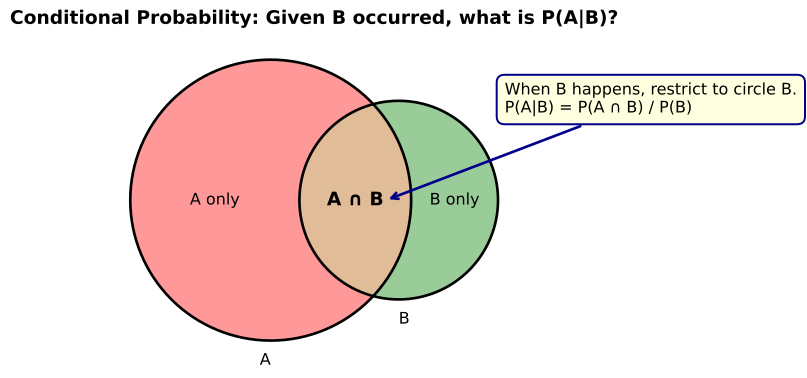
The Venn diagram below shows the general structure of conditional probability. When we condition on event B having occurred, we restrict our attention to the circle B. Within that circle, P(A∣B) represents the proportion of B that overlaps with A.
from pathlib import Path
import matplotlib.pyplot as plt
from matplotlib_venn import venn2, venn2_circles

# Generic Venn diagram
fig = plt.figure(figsize=(7, 4.5))
v = venn2(subsets=(3, 1, 1), set_labels=('A', 'B'))
venn2_circles(subsets=(3, 1, 1), linestyle='solid', linewidth=2)

lab = v.get_label_by_id('11')
if lab is not None:
    lab.set_text('A ∩ B')
    lab.set_fontsize(14)
    lab.set_fontweight('bold')

lab = v.get_label_by_id('01')
if lab is not None:
    lab.set_text('B only')
    lab.set_fontsize(12)

lab = v.get_label_by_id('10')
if lab is not None:
    lab.set_text('A only')
    lab.set_fontsize(12)

plt.title('Conditional Probability: Given B occurred, what is P(A|B)?', fontsize=14, fontweight='bold')
plt.annotate(
    'When B happens, restrict to circle B.\nP(A|B) = P(A ∩ B) / P(B)',
    xy=(0.67, 0.5), xycoords='axes fraction',
    xytext=(0.95, 0.85), textcoords='axes fraction',
    arrowprops=dict(arrowstyle='->', lw=2, color='darkblue'),
    ha='left', va='top',
    fontsize=12,
    bbox=dict(boxstyle='round,pad=0.5', facecolor='lightyellow', edgecolor='darkblue', linewidth=1.5)
)
plt.tight_layout()
fig.savefig("venn-conditional-generic.svg", format="svg", bbox_inches="tight")
Generic Venn diagram: P(A∣B) is the overlap relative to B.
from pathlib import Path
import matplotlib.pyplot as plt
from matplotlib_venn import venn2, venn2_circles

fig = plt.figure(figsize=(7, 4.5))
v = venn2(subsets=(9, 2, 2), set_labels=('A: at least one 3', 'B: sum = 9'))
venn2_circles(subsets=(9, 2, 2), linestyle='solid', linewidth=1)

lab = v.get_label_by_id('11')
if lab is not None:
    lab.set_text('A ∩ B\n(3,6)\n(6,3)\n\n(A|B)')

lab = v.get_label_by_id('01')
if lab is not None:
    lab.set_text('B only\n(4,5)\n(5,4)')

lab = v.get_label_by_id('10')
if lab is not None:
    lab.set_text('A only\n(…9 outcomes…)')

plt.title('Given B, restrict to circle B; A|B is the overlap')
plt.annotate(
    'We already know B happened\n→ restrict attention to circle B\n\u2234 P(A|B) is a ratio of P(A n B) to P(B)',
    xy=(0.75, .75), xycoords='axes fraction',
    xytext=(1, 0.95), textcoords='axes fraction',
    arrowprops=dict(arrowstyle='->', lw=1),
    ha='left', va='top'
)
plt.tight_layout()

fig.savefig("venn-dice-a-given-b.svg", format="svg", bbox_inches="tight")

# plt.show()
# plt.close(fig)
Example
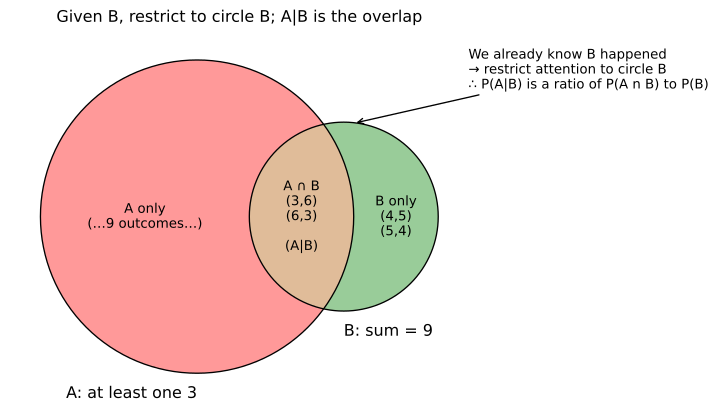
Two Dice — “At least one 3” given “sum is 9”
Roll two fair six‑sided dice.
Let A be the event “at least one die shows a 3”.
Let B be the event “the sum of the two dice is 9”.
We want the conditional probability P(A∣B).
Step 1 — List the outcomes in B
The outcomes (ordered pairs) that sum to 9 are:
Intuition: once we’re told B happened, the “new sample space” is just the 4 outcomes in B. In that restricted space, 2 of the 4 outcomes satisfy A, so P(A∣B)=2/4=1/2.
2. The Multiplication Rule for Conditional Probability
Rearranging the definition of conditional probability gives us the General Multiplication Rule, which is useful for calculating the probability of the intersection of two events:
This rule is particularly helpful when dealing with sequential events, where the outcome of the first event affects the probability of the second.
Example
Probability of drawing two Kings
Probability of drawing two Kings from a standard 52-card deck without replacement.
Let A be the event “the first card drawn is a King” and B be the event “the second card drawn is a King”.
We want to find P(A∩B).
Using the multiplication rule: P(A∩B)=P(B∣A)P(A).
P(A): There are 4 Kings in 52 cards, so P(A)=524.
P(B∣A): Given that the first card was a King, there are now 3 Kings left in the remaining 51 cards. So, P(B∣A)=513.
Sometimes, calculating the probability of an event A directly is difficult. However, we might know the conditional probabilities of A occurring under various mutually exclusive and exhaustive scenarios. The Law of Total Probability lets us combine those scenario-based probabilities into one overall probability.
Think of the Bi as “which scenario we are in.” First, one scenario Bi happens (with probability P(Bi)). Then, within that scenario, A happens with probability P(A∣Bi). The overall probability P(A) is a weighted average of the conditional probabilities P(A∣Bi), weighted by how likely each scenario is.
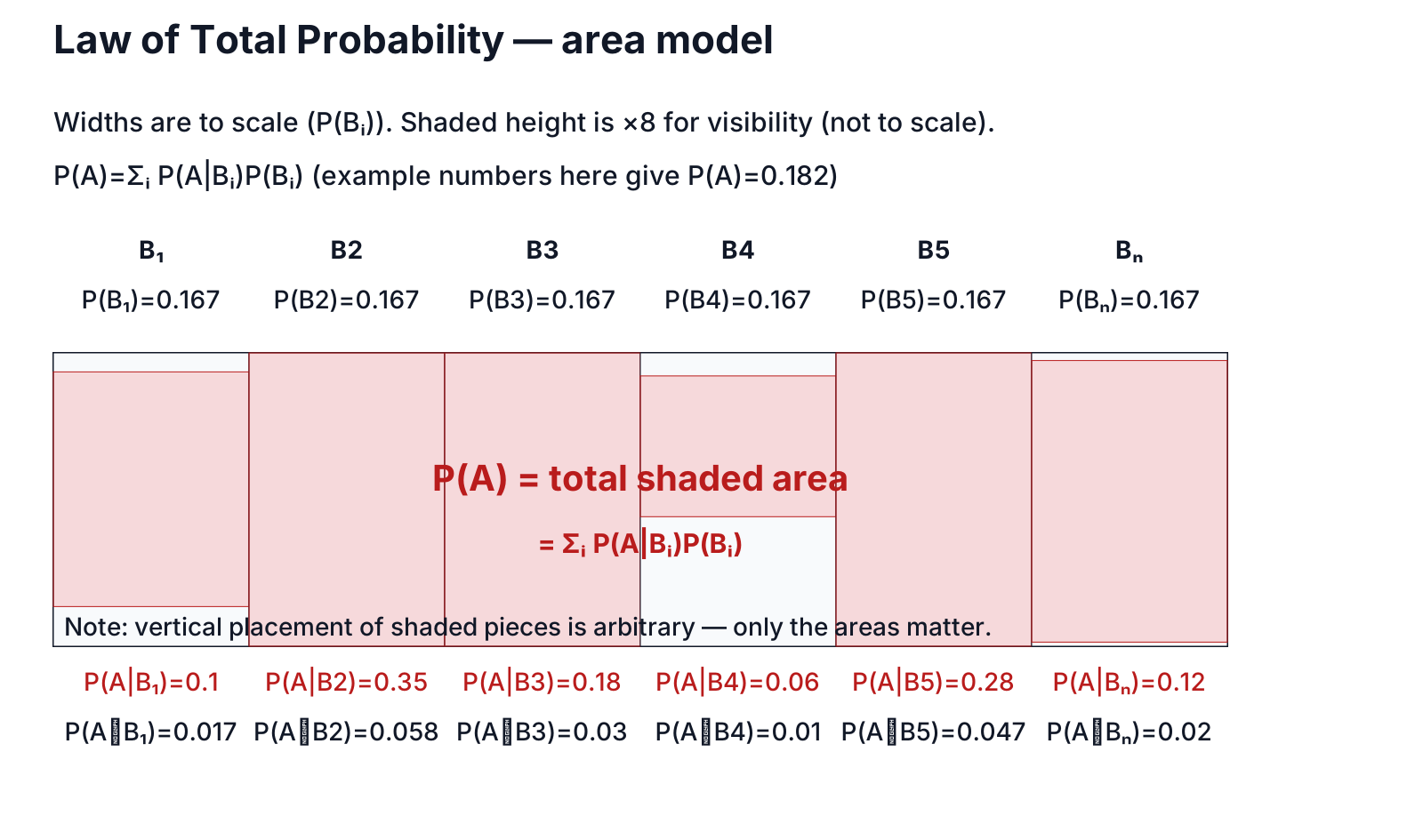
The sample space S is split into disjoint strips B1,…,Bn (a partition), so exactly one Bi occurs.
Each strip’s width represents P(Bi).
The shaded piece inside strip i represents the piece of A that lies in that strip, i.e. A∩Bi.
The (true) area of that piece is P(A∩Bi)=P(A∣Bi)P(Bi).
Adding the disjoint shaded pieces gives P(A).
# create and save visualisation total-probability-area.svg

from pathlib import Path
import random

def save_total_probability_svg(
    filename="total-probability-area.svg",
    n=6,
    p_B=None,
    p_A_given_B=None,
    magnify=8.0,
    font_scale=2.0,
    line_gap=2.0,
    jitter=True,
    jitter_seed=7,
):
    if p_B is None:
        p_B = [1/n] * n
    if p_A_given_B is None:
        p_A_given_B = [0.10, 0.35, 0.18, 0.06, 0.28, 0.12][:n]

    if len(p_B) != n or len(p_A_given_B) != n:
        raise ValueError("p_B and p_A_given_B must have length n.")

    # normalise widths
    s = sum(p_B)
    p_B = [x / s for x in p_B]

    def fmt(x):
        return f"{x:.3f}".rstrip("0").rstrip(".")

    pA = sum(pb * pab for pb, pab in zip(p_B, p_A_given_B))

    # ---------- sizing ----------
    W = 1600
    L = 60
    box_w, box_h = 1320, 330

    outline = "#111827"
    strip_fill = "#f8fafc"
    shade_fill = "#ef4444"
    shade_stroke = "#b91c1c"

    # fonts
    title_sz = int(22 * font_scale)
    note_sz  = int(15 * font_scale)
    B_sz     = int(14 * font_scale)
    num_sz   = int(14 * font_scale)   # "smallest" numbers
    inside_sz = int(15 * font_scale)
    center1  = int(20 * font_scale)
    center2  = int(15 * font_scale)

    # helper: line spacing in px (baseline-to-baseline)
    def dy(px):
        return int(px * line_gap)

    # ---------- top-down layout (prevents overlaps) ----------
    title_y = 60
    note1_y = title_y + dy(title_sz)
    note2_y = note1_y + dy(note_sz)

    header_bottom = note2_y + int(note_sz * 0.9)

    # Put B-label band BELOW header
    y_B  = header_bottom + dy(B_sz)        # B_i
    y_PB = y_B + dy(num_sz)                # P(B_i)

    # Put box BELOW B-label band
    y0 = y_PB + int(num_sz * 1.8)
    x0 = L
    y1 = y0 + box_h

    # Bottom labels below box
    y_bottom1 = y1 + int(num_sz * 1.8)
    y_bottom2 = y_bottom1 + dy(num_sz)

    # Total height
    H = y_bottom2 + int(num_sz * 4.0)

    # ---------- SVG ----------
    parts = []
    parts.append(f'<svg xmlns="http://www.w3.org/2000/svg" width="{W}" height="{H}" viewBox="0 0 {W} {H}">')
    parts.append('<rect x="0" y="0" width="100%" height="100%" fill="#ffffff"/>')

    # Header as separate text lines (cleaner than giant tspans at huge spacing)
    parts.append(f'''
<text x="{L}" y="{title_y}"
      font-family="system-ui, -apple-system, Segoe UI, Roboto, Helvetica, Arial"
      font-size="{title_sz}" font-weight="700" fill="{outline}">
  Law of Total Probability — area model
</text>
<text x="{L}" y="{note1_y}"
      font-family="system-ui, -apple-system, Segoe UI, Roboto, Helvetica, Arial"
      font-size="{note_sz}" fill="{outline}">
  Widths are to scale (P(Bᵢ)). Shaded height is ×{magnify:g} for visibility (not to scale).
</text>
<text x="{L}" y="{note2_y}"
      font-family="system-ui, -apple-system, Segoe UI, Roboto, Helvetica, Arial"
      font-size="{note_sz}" fill="{outline}">
  P(A)=Σᵢ P(A|Bᵢ)P(Bᵢ) (example numbers here give P(A)={fmt(pA)})
</text>
'''.strip())

    # Box
    parts.append(f'<rect x="{x0}" y="{y0}" width="{box_w}" height="{box_h}" fill="none" stroke="{outline}" stroke-width="2"/>')

    # Inside label
    parts.append(f'''
<text x="{x0+14}" y="{y0+int(inside_sz*1.2)}" text-anchor="start"
      font-family="system-ui, -apple-system, Segoe UI, Roboto, Helvetica, Arial"
      font-size="{inside_sz}" font-weight="800" fill="{outline}">S</text>
<text x="{x0+34}" y="{y0+int(inside_sz*1.2)}" text-anchor="start"
      font-family="system-ui, -apple-system, Segoe UI, Roboto, Helvetica, Arial"
      font-size="{inside_sz-1}" font-weight="600" fill="{outline}">partitioned into Bᵢ</text>
'''.strip())

    rng = random.Random(jitter_seed)

    x = x0
    for i, (pb, pab) in enumerate(zip(p_B, p_A_given_B), start=1):
        w = box_w * pb
        h_mag = min(box_h, box_h * pab * magnify)
        contrib = pb * pab
        cx = x + w/2

        if i == 1:
            lab = "B₁"
        elif i == n:
            lab = "Bₙ"
        else:
            lab = f"B{i}"

        # strip
        parts.append(
            f'<rect x="{x:.2f}" y="{y0}" width="{w:.2f}" height="{box_h}" '
            f'fill="{strip_fill}" stroke="{outline}" stroke-width="1"/>'
        )

        # shaded piece y-position (jittered)
        if jitter:
            max_top = y0
            max_bottom = y1 - h_mag
            y_shade = rng.uniform(max_top, max_bottom) if max_bottom > max_top else (y1 - h_mag)
        else:
            y_shade = y1 - h_mag

        parts.append(
            f'<rect x="{x:.2f}" y="{y_shade:.2f}" width="{w:.2f}" height="{h_mag:.2f}" '
            f'fill="{shade_fill}" fill-opacity="0.18" stroke="{shade_stroke}" stroke-width="1"/>'
        )

        # top labels (now safely below header)
        parts.append(
            f'<text x="{cx:.2f}" y="{y_B}" text-anchor="middle" '
            f'font-family="system-ui, -apple-system, Segoe UI, Roboto, Helvetica, Arial" '
            f'font-size="{B_sz}" font-weight="800" fill="{outline}">{lab}</text>'
        )
        parts.append(
            f'<text x="{cx:.2f}" y="{y_PB}" text-anchor="middle" '
            f'font-family="system-ui, -apple-system, Segoe UI, Roboto, Helvetica, Arial" '
            f'font-size="{num_sz}" fill="{outline}">P({lab})={fmt(pb)}</text>'
        )

        # bottom two lines with your requested bigger spacing
        parts.append(
            f'<text x="{cx:.2f}" y="{y_bottom1}" text-anchor="middle" '
            f'font-family="system-ui, -apple-system, Segoe UI, Roboto, Helvetica, Arial" '
            f'font-size="{num_sz}" fill="{shade_stroke}">P(A|{lab})={fmt(pab)}</text>'
        )
        parts.append(
            f'<text x="{cx:.2f}" y="{y_bottom2}" text-anchor="middle" '
            f'font-family="system-ui, -apple-system, Segoe UI, Roboto, Helvetica, Arial" '
            f'font-size="{num_sz}" fill="{outline}">P(A∩{lab})={fmt(contrib)}</text>'
        )

        x += w

    # Center red explanation
    center_x = x0 + box_w/2
    center_y = y0 + box_h/2
    parts.append(
        f'<text x="{center_x:.2f}" y="{center_y-10:.2f}" text-anchor="middle" '
        f'font-family="system-ui, -apple-system, Segoe UI, Roboto, Helvetica, Arial" '
        f'font-size="{center1}" font-weight="900" fill="{shade_stroke}">P(A) = total shaded area</text>'
    )
    parts.append(
        f'<text x="{center_x:.2f}" y="{center_y + dy(center2):.2f}" text-anchor="middle" '
        f'font-family="system-ui, -apple-system, Segoe UI, Roboto, Helvetica, Arial" '
        f'font-size="{center2}" font-weight="800" fill="{shade_stroke}">= Σᵢ P(A|Bᵢ)P(Bᵢ)</text>'
    )

    # Note for jitter placement (inside box, bottom-left)
    if jitter:
        parts.append(
            f'<text x="{x0+12}" y="{y1-12}" text-anchor="start" '
            f'font-family="system-ui, -apple-system, Segoe UI, Roboto, Helvetica, Arial" '
            f'font-size="{num_sz}" fill="{outline}">'
            f'Note: vertical placement of shaded pieces is arbitrary — only the areas matter.</text>'
        )

    parts.append("</svg>")
    Path(filename).write_text("\n".join(parts), encoding="utf-8")
    return filename

# Your call (works now without overlaps even at huge spacing):
save_total_probability_svg(
    "total-probability-area.svg",
    n=6,
    magnify=8.0,
    jitter=True,
    line_gap=2.0,
    font_scale=2.0
)
Area model: P(A) is the sum of the disjoint pieces A∩Bi.
3.5 Visual intuition: probability tree (same idea, different view)
A tree diagram shows the same logic: first choose which scenario Bi occurs, then (within that scenario) whether A occurs. (See section 4 for more detail on tree diagrams.)
On the branch S→Bi→A, the probability is the product P(Bi),P(A∣Bi). Summing those “A” leaves over all scenarios gives P(A).
Tree diagrams are a useful visualization tool for problems involving sequences of events, especially when conditional probabilities are involved.
Each branch represents an event.
The probability of each event is written on the branch.
Branches emanating from a single point represent mutually exclusive outcomes of a stage, and their probabilities should sum to 1.
The probability of reaching a specific endpoint (a sequence of events) is found by multiplying the probabilities along the path leading to that endpoint (using the Multiplication Rule).
The probability of an event that can occur via multiple paths is found by summing the probabilities of those paths (related to the Law of Total Probability).
Before looking at a specific example, let’s see the general pattern. Suppose we have a partition B1,B2,…,Bn of the sample space, and we’re interested in whether event A occurs. The tree diagram below shows how we first “choose” which scenario Bi happens, then (within that scenario) whether A occurs or not.
Reading the tree:
The first level shows the partition: exactly one of B1,B2,…,Bn occurs.
Each second-level branch shows whether A occurs (or doesn’t occur) given that particular scenario.
The probability of any complete path is the product of probabilities along that path. For example, the path Start → B1 → A has probability P(B1)×P(A∣B1)=P(A∩B1).
To find P(A), we sum the probabilities of all paths that end in A:
This is exactly the Law of Total Probability from section 3, just visualized as a tree instead of an area model.
Example
Visualizing the probabilities of outcomes in a sequence of two potentially biased coin flips.
Suppose a coin has P(Heads)=0.6 and P(Tails)=0.4. We flip it twice. The outcomes are independent.
5. Tips for differentiating between P(A∩B) and P(A∣B)
It can be challenging to differentiate between P(A∩B) and P(A∣B) in probability problems.
P(A∩B) represents the probability that both event A AND event B occur. Look for keywords like “and,” “both,” or phrases indicating a direct overlap between two characteristics. For example, “the probability that a student is an engineering major and is female.”
P(A∣B) signifies the probability of event A occurring GIVEN that event B has already occurred. This is a conditional probability, focusing on a subset of the population. Phrases such as “given that,” “of those who,” or “if a [characteristic B] is selected” are strong indicators. For instance, “Of the students who study engineering, 20% are female” is an example of P(Female∣Engineering).
The key distinction lies in whether the problem describes the likelihood of two events happening simultaneously (intersection) or the likelihood of one event happening under the condition that another event has already happened (conditional).
The core insight: Conditional probability P(A∣B) represents our updated belief about event A given that we know event B has occurred. It restricts the sample space to only outcomes where B is true.
Two Dice: If you roll two fair six-sided dice, what is the conditional probability that the sum is 8, given that the first die shows a 3? What is the conditional probability that the first die shows a 3, given that the sum is 8?
Answer
Let D1 be the result of the first die and D2 be the result of the second die. The total number of possible outcomes when rolling two fair six-sided dice is 6×6=36. Each outcome (D1, D2) is equally likely.
Part 1: Conditional probability that the sum is 8, given that the first die shows a 3.
Let A be the event that the sum is 8.
Let B be the event that the first die shows a 3.
We want to find P(A∣B).
The outcomes for event B (first die is 3) are:
{(3,1), (3,2), (3,3), (3,4), (3,5), (3,6)}. There are 6 such outcomes.
Given that the first die is 3, for the sum to be 8, the second die (D2) must be 8−3=5.
So, the only outcome where the first die is 3 and the sum is 8 is (3,5).
Thus, within the reduced sample space where the first die is 3, there is 1 outcome where the sum is 8.
Therefore, P(Sum=8∣First die=3)=1/6.
Alternatively, using the formula P(A∣B)=P(A∩B)/P(B):
P(B)=6/36=1/6.
P(A∩B) (sum is 8 and first die is 3) corresponds to the outcome (3,5), so P(A∩B)=1/36.
P(A∣B)=(1/36)/(6/36)=1/6.
Part 2: Conditional probability that the first die shows a 3, given that the sum is 8.
Let A be the event that the sum is 8.
Let B be the event that the first die shows a 3.
We want to find P(B∣A).
The outcomes for event A (sum is 8) are:
{(2,6), (3,5), (4,4), (5,3), (6,2)}. There are 5 such outcomes.
Given that the sum is 8, we look for outcomes where the first die is 3. The only such outcome is (3,5).
Thus, within the reduced sample space where the sum is 8, there is 1 outcome where the first die is 3.
Therefore, P(First die=3∣Sum=8)=1/5.
Alternatively, using the formula P(B∣A)=P(B∩A)/P(A):
P(A)=5/36.
P(B∩A) (first die is 3 and sum is 8) corresponds to the outcome (3,5), so P(B∩A)=1/36.
P(B∣A)=(1/36)/(5/36)=1/5.
Medical Test: A disease affects 1 in 1000 people. A test for the disease is 99% accurate (i.e., P(Positive | Disease) = 0.99) and has a 2% false positive rate (i.e., P(Positive | No Disease) = 0.02). Use the Law of Total Probability to calculate the overall probability that a randomly selected person tests positive. (We will revisit this in the Bayes’ Theorem chapter).
Answer
Let D be the event that a person has the disease, and ¬D be the event that a person does not have the disease.
Let + be the event that a person tests positive.
We are given:
P(D)=1/1000=0.001
P(Positive∣D)=P(+∣D)=0.99 (test accuracy for those with the disease)
P(Positive∣¬D)=P(+∣¬D)=0.02 (false positive rate)
From P(D), we can find P(¬D):
P(¬D)=1−P(D)=1−0.001=0.999
We need to calculate the overall probability that a randomly selected person tests positive, P(+). We use the Law of Total Probability:
P(+)=P(+∣D)⋅P(D)+P(+∣¬D)⋅P(¬D)P(+)=(0.99⋅0.001)+(0.02⋅0.999)P(+)=0.00099+0.01998P(+)=0.02097
So, the overall probability that a randomly selected person tests positive is 0.02097, or about 2.097%.
Two Cards — Same Rank: Draw two cards from a standard 52-card deck without replacement. What is the probability that the two cards have the same rank (e.g., two 7s, two Kings)?
Answer
Let M be the event “the two cards have the same rank.”
Conditional probability approach (matches the hint):
The first card can be anything; after drawing it, its rank is fixed.
In a 52-card deck there are 4 cards of each rank.
After drawing the first card, there are 3 remaining cards of that same rank.
There are 51 cards left in total.
So,
P(M)=P(2nd card has same rank as 1st∣1st card drawn).
To make this concrete, let B be the event “the first card is an Ace” and let C be the event “the second card is an Ace”.
Then C∩B is the event “the first two cards are both Aces”.