Welcome to Part 3 of our journey! We’ve built a solid foundation in basic probability, counting, conditional probability, and independence. Now, we introduce a central concept that bridges probability theory and data analysis: the Random Variable. Random variables allow us to quantitatively describe the outcomes of random phenomena. In this chapter, we’ll focus specifically on Discrete Random Variables, which take on a finite or countably infinite number of values. We’ll learn how to describe their behavior using Probability Mass Functions (PMFs) and Cumulative Distribution Functions (CDFs), and how to summarize them using measures like Expected Value (Mean) and Variance.
What is a Random Variable?
In many experiments, we’re not interested in the specific outcome itself, but rather in some numerical property associated with that outcome.
Definition: A Random Variable is a variable whose value is a numerical outcome of a random phenomenon. More formally, it’s a function that maps each outcome in the sample space to a real number.
We typically denote random variables with uppercase letters (e.g., ) and their specific values with lowercase letters (e.g., ).
Types of Random Variables:
Discrete Random Variable: A random variable that can only take on a finite or countably infinite number of distinct values. Often associated with counting processes.
Continuous Random Variable: A random variable that can take on any value within a given range or interval. Often associated with measurement processes. (We’ll cover these in Chapter 8).
Example: Consider rolling a fair six-sided die.
The sample space is .
We can define a random variable to be the number shown on the die after the roll. maps each outcome (which is already a number in this case) to itself.
is a discrete random variable because it can only take on the specific values .
Another Example: Consider flipping a coin twice.
The sample space is .
Let be the random variable representing the number of heads obtained.
maps the outcomes to numbers: , , , .
is a discrete random variable because it can only take on the values .
Probability Mass Function (PMF)
For a discrete random variable, we want to know the probability associated with each possible value it can take. This is captured by the Probability Mass Function (PMF).
Definition: The Probability Mass Function (PMF) of a discrete random variable is a function, denoted by or simply , that gives the probability that is exactly equal to some value .
A valid PMF must satisfy two conditions:
for all possible values . (Probabilities cannot be negative).
, where the sum is taken over all possible values that can assume. (The total probability must be 1).
Example: Fair Die PMF
For the fair die roll, let be the outcome. The possible values are . Since the die is fair, each outcome has a probability of . The PMF is:
So, , , ..., .
The sum is .
Let’s represent and visualize this PMF in Python.
Python Implementation
This code creates the PMF for a fair die by defining the possible values and their probabilities. We use a dictionary to represent the PMF for easy lookup and verify that probabilities sum to 1.
from pprint import pprint

# Define the possible outcomes (values) and their probabilities for the die roll
die_values = np.arange(1, 7) # Possible values x: 1, 2, 3, 4, 5, 6
die_probs = np.array([1/6] * 6) # P(X=x) for each value

# Create a dictionary for easier lookup
die_pmf_dict = {val: prob for val, prob in zip(die_values, die_probs)}
print("PMF Dictionary:")
pprint(die_pmf_dict)
print(f"\nSum of probabilities: {sum(die_pmf_dict.values()):.10f}")
PMF Dictionary:
{np.int64(1): np.float64(0.16666666666666666),
np.int64(2): np.float64(0.16666666666666666),
np.int64(3): np.float64(0.16666666666666666),
np.int64(4): np.float64(0.16666666666666666),
np.int64(5): np.float64(0.16666666666666666),
np.int64(6): np.float64(0.16666666666666666)}
Sum of probabilities: 1.0000000000
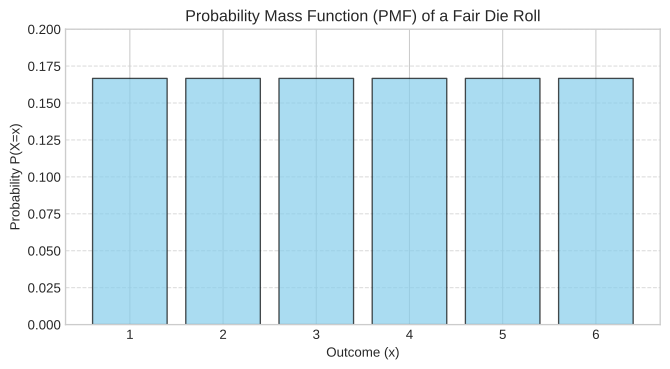
PMF of a fair die roll showing uniform probability of 1/6 for each outcome.
Cumulative Distribution Function (CDF)
Sometimes, we are interested not just in the probability of being exactly a certain value, but in the probability that is less than or equal to a certain value. This is captured by the Cumulative Distribution Function (CDF).
Definition: The Cumulative Distribution Function (CDF) of a random variable (discrete or continuous), denoted by or simply , gives the probability that takes on a value less than or equal to .
For a discrete random variable , the CDF is calculated by summing the PMF values for all outcomes less than or equal to :
Properties of a CDF:
for all .
is a non-decreasing function of : if , then .
and .
For a discrete random variable, the CDF is a step function, increasing at the points where the PMF is positive.
.
for .
(the size of the jump at ).
Example: CDF Calculations for Fair Die
For the fair die roll :
Let’s calculate and visualize the CDF.
Python Implementation
This code demonstrates how to calculate the CDF by cumulatively summing the PMF values. We then create a function die_cdf_func(x) that can evaluate the CDF at any point, handling values below 1, above 6, and in between.
from pprint import pprint

# Setup: Define die values and probabilities
die_values = np.arange(1, 7)  # Possible values: 1, 2, 3, 4, 5, 6
die_probs = np.array([1/6] * 6)  # Equal probability for fair die

# Calculate the CDF values
die_cdf_values = np.cumsum(die_probs)
print("CDF Values:")
for i, cdf_val in enumerate(die_cdf_values, start=1):
    print(f"  F({i}) = {cdf_val:.4f}")

# Create a function representation of the CDF
def die_cdf_func(x):
    if x < 1:
        return 0.0
    elif x >= 6:
        return 1.0
    else:
        # For values between die outcomes, CDF remains constant at the last "step"
        # So we find which die value we've passed and return that CDF value
        idx = np.searchsorted(die_values, x, side='right') - 1
        return die_cdf_values[idx]

# Test the function at non-integer values to see step function behavior
print("\nTesting CDF between steps:")
print(f"  F(0.5) = {die_cdf_func(0.5):.4f}  (before first outcome)")
print(f"  F(3.7) = {die_cdf_func(3.7):.4f}  (between 3 and 4, stays at F(3))")
print(f"  F(10)  = {die_cdf_func(10):.4f}  (after last outcome)")
CDF Values:
F(1) = 0.1667
F(2) = 0.3333
F(3) = 0.5000
F(4) = 0.6667
F(5) = 0.8333
F(6) = 1.0000
Testing CDF between steps:
F(0.5) = 0.0000 (before first outcome)
F(3.7) = 0.5000 (between 3 and 4, stays at F(3))
F(10) = 1.0000 (after last outcome)
The plot below visualizes the CDF as a step function. Notice how the function jumps at each integer value (where the die can actually land) and remains constant between integers. The filled circles show the value of the CDF at each point, while the open circles indicate the value just before the jump.
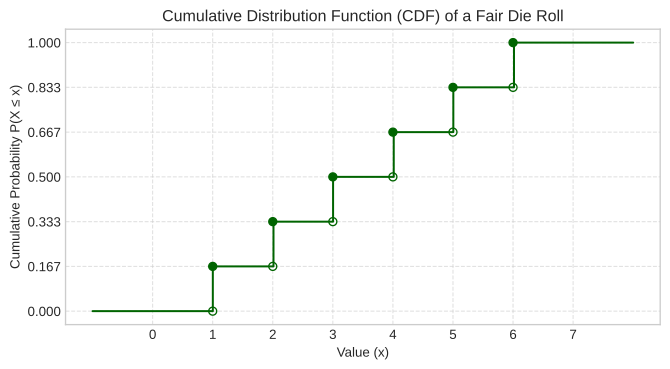
CDF of a fair die roll showing the cumulative probability as a step function.
Expected Value (Mean)
The expected value, or mean, of a discrete random variable is a weighted average of its possible values, where the weights are the probabilities (PMF values). It represents the long-run average value we would expect if we observed the random variable many times.
Definition: The Expected Value (or Mean) of a discrete random variable , denoted by or , is defined as:
where the sum is over all possible values that can take.
The expected value doesn’t have to be one of the possible values of .
Example: Calculating Expected Value
For the fair die roll :
Even though the die can never land on 3.5, the long-run average value of many rolls is expected to be 3.5.
Python Implementation
This code calculates the expected value using the formula . We use np.sum() to compute the weighted sum of values times probabilities.
# Setup: Define die values and probabilities
die_values = np.arange(1, 7)  # Possible values: 1, 2, 3, 4, 5, 6
die_probs = np.array([1/6] * 6)  # Equal probability for fair die

# Calculate the expected value
expected_value = np.sum(die_values * die_probs)
# Alternatively using dot product:
# expected_value = np.dot(die_values, die_probs)

print(f"Theoretical Expected Value E[X]: {expected_value}")
Theoretical Expected Value E[X]: 3.5
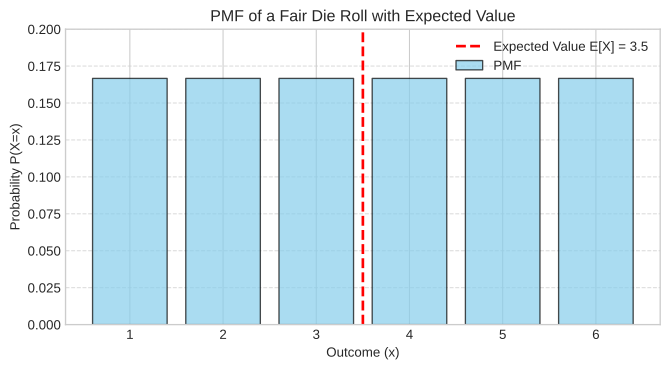
PMF with expected value marked at 3.5, the theoretical long-run average.
Variance and Standard Deviation
While the expected value tells us the center of the distribution, the variance and standard deviation measure the spread or dispersion of the random variable’s values around the mean.
Definition: The Variance of a random variable , denoted by or , is the expected value of the squared difference between and its mean .
For a discrete random variable, this is calculated as:
A computationally simpler formula for variance is often used:
where .
Definition: The Standard Deviation of a random variable , denoted by or , is the positive square root of the variance.
The standard deviation is often preferred because it has the same units as the random variable .
Example: Calculating Variance and Standard Deviation
Python Implementation
This code calculates variance using the computational formula . We also show the alternative calculation using the definition to verify they give the same result.
# Setup: Define die values and probabilities
die_values = np.arange(1, 7)  # Possible values: 1, 2, 3, 4, 5, 6
die_probs = np.array([1/6] * 6)  # Equal probability for fair die
expected_value = np.sum(die_values * die_probs)  # E[X] = 3.5

# Calculate E[X^2]
e_x_squared = np.sum((die_values**2) * die_probs)
print(f"E[X^2]: {e_x_squared:.4f} (Exact: 91/6)")

# Calculate Variance using the computational formula
variance = e_x_squared - (expected_value**2)
print(f"Theoretical Variance Var(X): {variance:.4f} (Exact: 35/12)")

# Alternatively, calculate using the definition: E[(X - mu)^2]
variance_def = np.sum(((die_values - expected_value)**2) * die_probs)
print(f"Variance using definition: {variance_def:.4f}")

# Calculate Standard Deviation
std_dev = np.sqrt(variance)
print(f"Theoretical Standard Deviation SD(X): {std_dev:.4f} (Exact: sqrt(35/12))")
E[X^2]: 15.1667 (Exact: 91/6)
Theoretical Variance Var(X): 2.9167 (Exact: 35/12)
Variance using definition: 2.9167
Theoretical Standard Deviation SD(X): 1.7078 (Exact: sqrt(35/12))
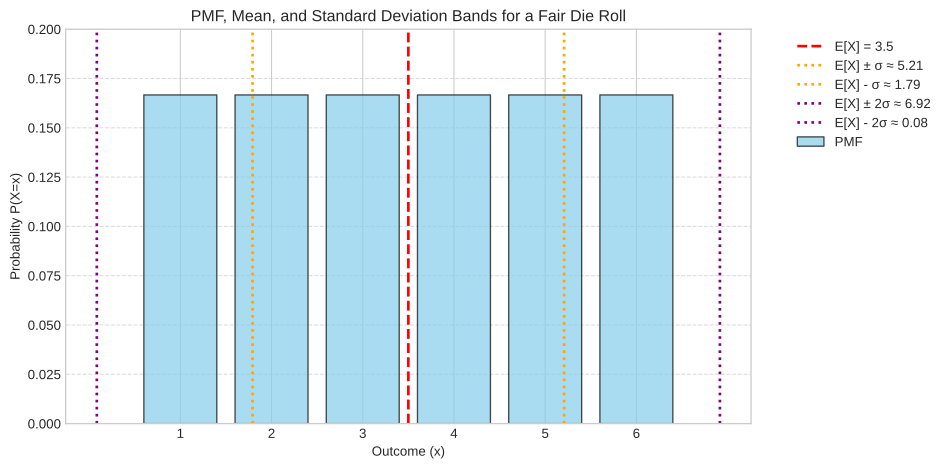
PMF showing mean and standard deviation bands, illustrating the spread of the distribution.
Functions of a Random Variable
Often, we are interested in a quantity that is derived from a random variable. If is a random variable and is a function, then is also a random variable.
If is discrete with PMF , we can find the PMF of , denoted , by summing the probabilities of all values such that :
Expected Value of a Function of a Random Variable (LOTUS)
A very useful result, sometimes called the Law of the Unconscious Statistician (LOTUS), allows us to calculate the expected value of without explicitly finding the PMF of .
Definition: For a discrete random variable with PMF and a function , the expected value of is:
Compare this to the definition of :
Notice that we simply replace with in the summation. This is how we calculated earlier, where .
Example: PMF and Expected Value of Y = X²
Let be the outcome of a fair die roll. Let . What are the PMF and expected value of ?
The possible values of are , each with probability .
The possible values of are .
Since each value maps to a unique value, the probability of each is the same as the probability of the corresponding .
The PMF of is: for , and 0 otherwise.
Calculating E[Y] using the PMF of Y:
Alternatively, using LOTUS:
This confirms our earlier calculation of .
Python Implementation
This code demonstrates two methods for calculating where : first by finding the PMF of and using it directly, and second by using LOTUS to calculate directly from without finding the PMF of . Both methods give the same result.
from pprint import pprint

# Setup: Define die values and probabilities
die_values = np.arange(1, 7)  # Possible values: 1, 2, 3, 4, 5, 6
die_probs = np.array([1/6] * 6)  # Equal probability for fair die

# Define the function g(x) = x^2
def g(x):
  return x**2

# Possible values for X and Y
x_values = die_values
y_values = g(x_values)

# PMF for Y (since g(x) is one-to-one for x in {1..6}, probs are the same)
y_probs = die_probs

# PMF dictionary for Y
y_pmf_dict = {val_y: prob for val_y, prob in zip(y_values, y_probs)}
print("PMF Dictionary for Y=X^2:")
pprint(y_pmf_dict)

# Calculate E[Y] using the PMF of Y
expected_value_y = np.sum(y_values * y_probs)
print(f"\nE[Y] calculated using PMF of Y: {expected_value_y:.4f} (Exact: 91/6)")

# Calculate E[Y] = E[g(X)] using LOTUS
expected_value_y_lotus = np.sum(g(x_values) * die_probs)
print(f"E[Y] calculated using LOTUS E[g(X)]: {expected_value_y_lotus:.4f} (Exact: 91/6)")
PMF Dictionary for Y=X^2:
{np.int64(1): np.float64(0.16666666666666666),
np.int64(4): np.float64(0.16666666666666666),
np.int64(9): np.float64(0.16666666666666666),
np.int64(16): np.float64(0.16666666666666666),
np.int64(25): np.float64(0.16666666666666666),
np.int64(36): np.float64(0.16666666666666666)}
E[Y] calculated using PMF of Y: 15.1667 (Exact: 91/6)
E[Y] calculated using LOTUS E[g(X)]: 15.1667 (Exact: 91/6)
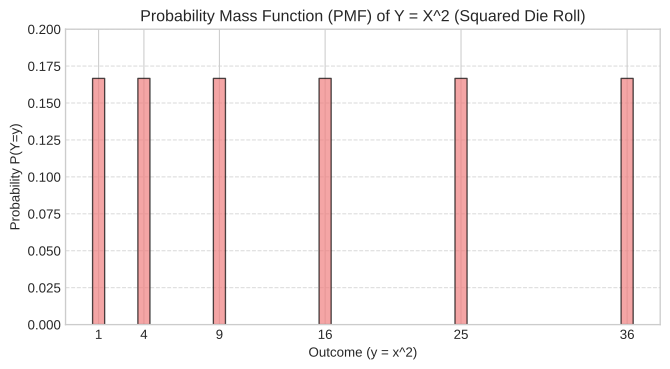
PMF of showing the transformed distribution.
Hands-on: Simulation and Comparison
The Law of Large Numbers (which we’ll study later) tells us that if we simulate a random variable many times, the average of the outcomes (the sample mean) should get close to the theoretical expected value . Similarly, the variance of the outcomes (the sample variance) should approach . Let’s verify this for our die roll example.
We will:
Simulate a large number of fair die rolls using
numpy.random.randint.Calculate the sample mean and sample variance of the simulated outcomes.
Compare these empirical results to the theoretical values (, ).
Visualize the distribution of the simulated outcomes (empirical PMF) and compare it to the theoretical PMF.
Visualize the empirical CDF and compare it to the theoretical CDF.
# Setup: Calculate theoretical values
die_values = np.arange(1, 7)
die_probs = np.array([1/6] * 6)
expected_value = np.sum(die_values * die_probs)  # E[X] = 3.5
variance = np.sum((die_values**2) * die_probs) - expected_value**2  # Var(X) = 35/12
std_dev = np.sqrt(variance)  # SD(X)

# Number of simulations
num_simulations = 10000

# Simulate die rolls
simulated_rolls = np.random.randint(1, 7, size=num_simulations)

# Calculate empirical mean and variance
sample_mean = np.mean(simulated_rolls)
sample_variance = np.var(simulated_rolls, ddof=1)  # ddof=1 for unbiased estimator
sample_std_dev = np.std(simulated_rolls, ddof=1)

# Compare empirical vs theoretical
print(f"--- Comparison after {num_simulations} simulations ---")
print(f"Theoretical E[X]: {expected_value:.4f}")
print(f"Sample Mean:      {sample_mean:.4f}")
print(f"Difference (Mean): {abs(sample_mean - expected_value):.4f}\n")

print(f"Theoretical Var(X): {variance:.4f}")
print(f"Sample Variance:    {sample_variance:.4f}")
print(f"Difference (Var):   {abs(sample_variance - variance):.4f}\n")

print(f"Theoretical SD(X): {std_dev:.4f}")
print(f"Sample Std Dev:     {sample_std_dev:.4f}")
print(f"Difference (SD):    {abs(sample_std_dev - std_dev):.4f}")
--- Comparison after 10000 simulations ---
Theoretical E[X]: 3.5000
Sample Mean: 3.4772
Difference (Mean): 0.0228
Theoretical Var(X): 2.9167
Sample Variance: 2.9388
Difference (Var): 0.0221
Theoretical SD(X): 1.7078
Sample Std Dev: 1.7143
Difference (SD): 0.0065
Visualizing Empirical vs Theoretical Distributions
Now let’s plot the frequencies of our simulated results and compare them to the theoretical probabilities (PMF), and do the same for the cumulative distributions (CDF).
# Calculate empirical PMF and CDF
unique_outcomes, counts = np.unique(simulated_rolls, return_counts=True)
empirical_pmf = counts / num_simulations
empirical_cdf = np.cumsum(empirical_pmf)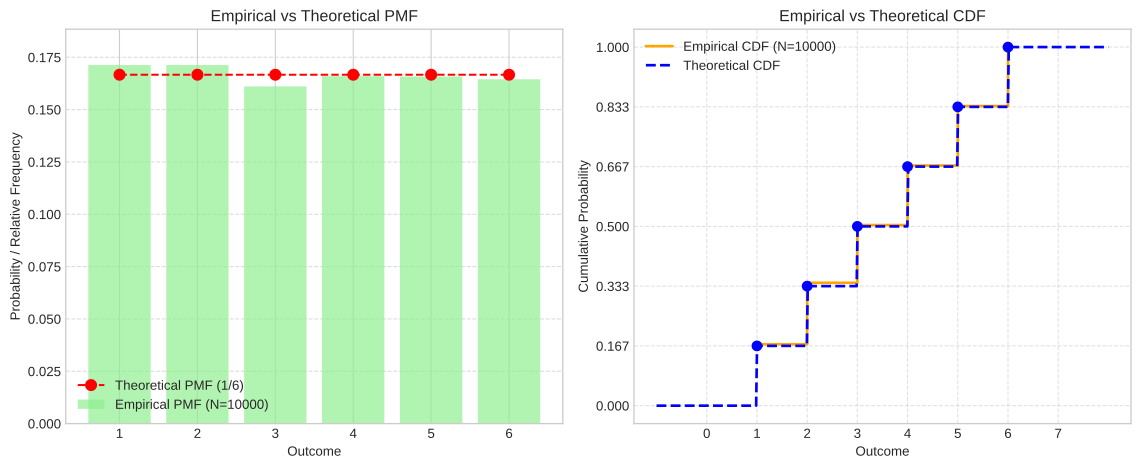
Comparison of empirical (simulated) and theoretical distributions, demonstrating convergence.
As you can see from the simulation results and the plots, the empirical values (sample mean, sample variance, empirical PMF/CDF) obtained from a large number of simulations closely approximate the theoretical values we derived. This demonstrates the connection between probability theory and real-world observations or simulations.
Summary
In this chapter, we introduced the fundamental concept of a discrete random variable.
A Random Variable assigns a numerical value to each outcome of a random experiment.
A Discrete Random Variable takes on a finite or countably infinite number of values.
The Probability Mass Function (PMF), , gives the probability for each possible value .
The Cumulative Distribution Function (CDF), , gives the cumulative probability up to a value .
The Expected Value (Mean), , represents the long-run average value.
The Variance, , measures the spread around the mean.
The Standard Deviation, , also measures spread but in the original units.
We can analyze Functions of Random Variables, , and find their PMFs by summing probabilities: .
LOTUS (Law of the Unconscious Statistician) allows us to calculate expected values of functions directly: .
Simulations using Python (
numpy) allow us to generate empirical data that converges to theoretical probability distributions and their parameters as the number of simulations increases.
In the next chapter, we will explore several important families of discrete distributions that model common real-world scenarios.
Exercises
Biased Coin: Consider a biased coin where the probability of getting Heads (H) is . Let be the random variable representing the number of heads in a single flip (so for Heads, for Tails). a. What is the PMF of ? b. What is the CDF of ? Plot it. c. Calculate the expected value . d. Calculate the variance and standard deviation .
Answera) PMF: ,
b) CDF: for ; for ; for
c)
d)
Two Dice Sum: Let be the random variable representing the sum of the outcomes when two fair six-sided dice are rolled. a. What are the possible values for ? b. Determine the PMF of . (Hint: There are 36 equally likely outcomes for the pair of dice.) c. Calculate . Is there an easier way than using the PMF directly? (Hint: Linearity of Expectation) d. Calculate . (Hint: Variance of sums of independent variables) e. Find . f. Find .
Answera) Possible values:
b) PMF: Count outcomes for each sum. For example, (six ways: 1+6, 2+5, 3+4, 4+3, 5+2, 6+1)
c) Using linearity:
d) For independent dice:
e)
f) Count even sums:
Game Value: You pay £2 to play a game. You roll a fair six-sided die. If you roll a 6, you win £5 (getting your £2 back plus £3 profit). If you roll a 4 or 5, you win £2 (getting your £2 back). If you roll a 1, 2, or 3, you win nothing (losing your £2). Let be the random variable representing your net winnings (profit/loss) from playing the game once. a. What are the possible values for ? b. Determine the PMF of . c. Calculate the expected net winnings . Is this a fair game? (A fair game has ). d. Calculate the variance .
Answera) Possible values: (net: lose £2, break even, or profit £3)
b) PMF:
(roll 1, 2, or 3)
(roll 4 or 5)
(roll 6)
c)
Not fair; expected loss of £0.50 per game
d)
Simulation Comparison: Simulate rolling two fair dice and calculating their sum times. a. Calculate the sample mean and sample variance of the simulated sums. b. Compare these to the theoretical values you calculated in Exercise 2. c. Plot the empirical PMF of the simulated sums and compare it to the theoretical PMF from Exercise 2.
(Solutions/Hints Appendix)
Example Code for Exercise 1
# Exercise 1: Biased Coin
p_heads = 0.7
p_tails = 1 - p_heads

# a) PMF
x_values_coin = np.array([0, 1]) # 0 for Tails, 1 for Heads
pmf_coin = np.array([p_tails, p_heads])
pmf_coin_dict = {val: prob for val, prob in zip(x_values_coin, pmf_coin)}
print(f"Ex 1(a) - PMF: {pmf_coin_dict}")

# b) CDF
cdf_coin_values = np.cumsum(pmf_coin)
def coin_cdf_func(x):
    if x < 0: return 0.0
    if x >= 1: return 1.0
    return cdf_coin_values[0] # P(X<=0)

# c) Expected Value
ex_coin = np.sum(x_values_coin * pmf_coin)
print(f"Ex 1(c) - E[X]: {ex_coin}")

# d) Variance
ex2_coin = np.sum((x_values_coin**2) * pmf_coin)
var_coin = ex2_coin - ex_coin**2
sd_coin = np.sqrt(var_coin)
print(f"Ex 1(d) - Var(X): {var_coin:.4f}")
print(f"Ex 1(d) - SD(X): {sd_coin:.4f}")
Ex 1(a) - PMF: {np.int64(0): np.float64(0.30000000000000004), np.int64(1): np.float64(0.7)}
Ex 1(c) - E[X]: 0.7
Ex 1(d) - Var(X): 0.2100
Ex 1(d) - SD(X): 0.4583