17 · Virtual Memory
Chapter header
| Target | xv6 — the teaching kernel under QEMU |
| Prerequisites | ch16 |
| What it measures | The page-table shape of a running process: levels, entries, and physical pages consumed per mapping: bench/results/pagetable-xv6.json |
The question
What is an address, and who decides what it means?
Every chapter so far has treated an address as a number that names a place. ch15 watched a loader put a program at the address its linker chose, and ch16 left a promise: the trampoline page is mapped into two address spaces at once. That sentence only makes sense if an address means different things to different programs, and it does. This chapter is about the page tables that arrange it, and about what they cost — not in time, which this target cannot tell you, but in the memory it takes to say where memory is.
The material
An address is a question
The instruction ld a0, 0(a1) does not name a location. It names a number, and something between
the core and the memory has to decide what that number refers to. On this machine the decision is
made by a data structure in memory, and one register says where that structure begins.
That register is satp. Writing to it replaces every address in the running program’s world at a
stroke, which is why ch16’s trap path switches it and why the trampoline has to be mapped
at the same address in both maps — the instruction after the switch has to still exist.
So “what is an address” has a precise answer. An address is a question, satp names who
answers, and the answer is looked up rather than computed.
Nine, nine, nine, twelve
The scheme is called Sv39, and two decisions force the whole of its layout. There is nothing arbitrary in it to memorise.
Choose a page size, and choose how big an entry describing a page must be. Everything else follows: a table is one page of entries, so the number of entries per table is one divided by the other, and the number of bits needed to index a table is the logarithm of that. Stack enough levels to reach a useful address width and you have the whole design.
| Value | Where it comes from | |
|---|---|---|
| Page size | 4096 bytes | chosen |
| Page-table entry | 8 bytes | chosen |
| Entries per table | 512 | page ÷ entry |
| Index bits per level | 9 | log₂(entries) |
| Levels | 3 | to reach 39 bits |
| One level-0 entry covers | 4096 bytes | a page |
| One level-1 entry covers | 2097152 bytes | 512 pages |
| One level-2 entry covers | 1073741824 bytes | 512 of those |
Conditions: target xv6 · qemu virt (-machine virt -bios none) · QEMU emulator version 8.2.2 (Debian 1:8.2.2+ds-0ubuntu1.18) · xv6-riscv @ 9e3161a · riscv64-linux-gnu-gcc (Ubuntu 13.3.0-6ubuntu2~24.04.1) 13.3.0 · xv6's own CFLAGS · 2026-09-17 · Source: bench/results/pagetable-xv6.json, code hash e2b798006ccdfc0d.
Read the right-hand column. Only the first two rows were chosen. Nine bits per level is not a tuning parameter — it is what a 4096-byte page holding 8-byte entries makes you use, and a designer who picked a different page size would get a different number of levels rather than a different number of bits.
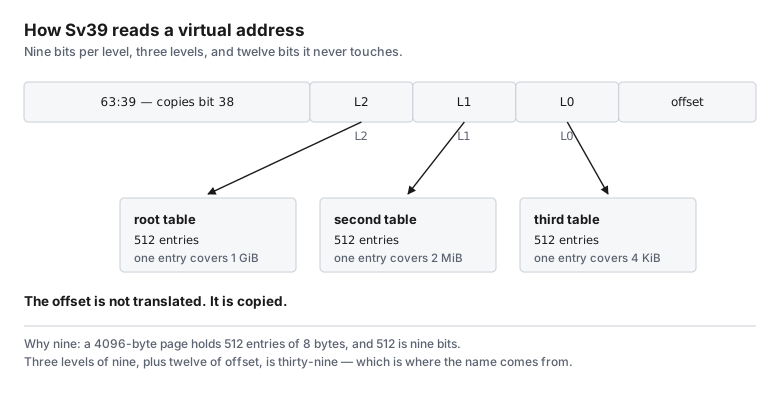
One virtual address, and the four things translation does with it.
Two details in that figure are easy to miss.
The offset is not translated. The bottom twelve bits are copied from the virtual address to the physical one, untouched. Translation moves pages about; it has no opinion about where in a page a byte is. That is why a page is the unit of everything in this chapter: it is the smallest thing the mechanism can say anything about.
The top twenty-five bits are not spare. Sv39 translates thirty-nine bits, and the rest of the word must all copy bit 38 — a sign extension, the top bit copied into every bit above it, which is how a narrow signed number is widened. An address that fails that rule is not an address that is out of range; it is not an address, and the hardware refuses it. xv6 declines to use the top half at all, capping its address space one bit below the maximum so that every address it ever forms has bit 38 clear and the question never arises.
A fault is a walk that stopped
Follow the indices down and one of three things happens. An entry with its valid bit clear ends the walk. An entry with valid set and none of read, write or execute points at the next table down. An entry with valid set and any of them is a leaf, and the walk is over.
So a failed translation has a location. It is not “this address is wrong” but “the walk got this far and stopped”, and which level it stopped at says something different each time. Stopping at the top level means nothing in that gigabyte of the address space exists. Stopping at the bottom means the neighbourhood is mapped and this particular page is not — a stack that has grown one page too far, say, rather than a wild pointer. ch18 is about what a kernel can do with that distinction; problem 17.3 is about extracting it.
Two clusters and five tables
The rest of this section counts pages of table.
init is the first program xv6 runs, and the smallest interesting address space in the system. It
maps six pages. Describing those six pages takes five more.
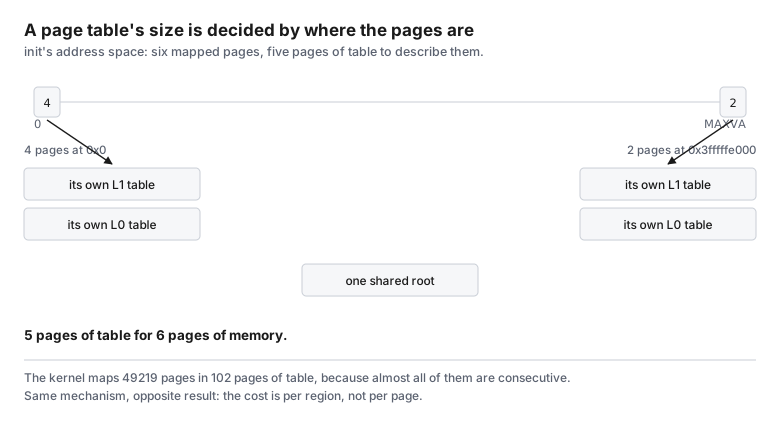
Why six mapped pages need five pages of table.
The six are not in one place. Four are at the bottom of the address space, where the linker put the program. Two are at the very top: the trapframe — the page the trap path saves its thirty-one registers into — and the trampoline, which ch16 put there. Those two clusters are separated by almost the whole of a 512-gigabyte address space, so neither can reuse any of the other’s tables — each forces its own chain down from the shared root.
A chain is two pages whether it ends in one mapping or five hundred.
The map costs memory
Put the totals side by side.
| Address space | Page-table pages | Pages mapped | Separate regions | Overhead |
|---|---|---|---|---|
kernel | 102 | 49219 | 67 | 0.207% |
init | 5 | 6 | 2 | 83.3% |
Conditions: target xv6 · qemu virt (-machine virt -bios none) · QEMU emulator version 8.2.2 (Debian 1:8.2.2+ds-0ubuntu1.18) · xv6-riscv @ 9e3161a · riscv64-linux-gnu-gcc (Ubuntu 13.3.0-6ubuntu2~24.04.1) 13.3.0 · xv6's own CFLAGS · 2026-09-17 · Source: bench/results/pagetable-xv6.json, code hash e2b798006ccdfc0d.
The kernel maps an enormous amount of memory and spends almost nothing per page describing it. init maps almost nothing and spends nearly as much on the description as on the thing described. The last column explains both: the kernel’s memory arrives in a handful of vast runs, and init’s in two tiny ones.
Two of the kernel’s regions account for nearly everything it maps. One is the whole of the RAM it manages, direct-mapped so that a physical address and a kernel virtual address are the same number — a deliberate decision that makes the kernel’s own pointers translatable without any bookkeeping at all. The other is a run of device registers so long that three separate devices, laid out end to end by the machine’s designers, come out as a single region: the census cannot tell them apart, because as far as the page table is concerned they are not different things.
Almost every remaining region is a single page, and they are kernel stacks. xv6 leaves an unmapped page between every pair of them, so that a kernel stack which overflows hits nothing rather than quietly writing into its neighbour. Each of those guard pages costs nothing — an absent mapping is an entry that is not there — and the arrangement costs one shared table for the lot, because they are all in the same two megabytes.
The most expensive two pages in the system
Go back to init’s five tables and ask which mapping is responsible for which.
The four pages at the bottom need a chain of two — one middle table, one last — under the shared root. Three pages of table for four pages of program, and every further page the program allocates is free until it crosses two megabytes.
The two pages at the top need another middle table and another last table, because nothing else is within a gigabyte of them. Two pages of table for two pages of mapping, and every process in the system pays it.
Those two pages are the trapframe and the trampoline. The trap path ch16 measured in instructions has a second price that chapter could not express: per process, two pages of table, for as long as the process exists. Neither number is a cost in the sense this book usually means — ch29 is where traps get priced in time — but both are real, and the second one is invisible unless somebody counts it.
The model and the kernel
The numbers above were obtained twice over, by two independent routes.
The kernel counts its own tables by walking them. Separately, sysfs/lib/sv39.c computes how
many tables a set of mappings requires, from the addresses alone, with no machine involved:
uint64_t sysfs_sv39_tables(const struct sysfs_sv39_run *runs, size_t count, uint64_t out[3]) {
  /* One root, always. Below it, a level-1 table is needed for each distinct gigabyte the runs
   * touch and a level-0 table for each distinct two megabytes — so the answer depends on where
   * the pages are and not at all on how many of them there are.
   *
   * Runs arrive sorted, so distinctness is a comparison with the previous chunk rather than a
   * set. That is not only cheaper; it is the reason this fits in a page of C. */
  uint64_t gigabytes = 0, leaves = 0;
  uint64_t previous_gib = 0, previous_2mib = 0;
  int started = 0;

  for (size_t i = 0; i < count; i++) {
    uint64_t first = runs[i].start;
    uint64_t last = first + runs[i].pages * SYSFS_SV39_PAGE_BYTES - 1;
    for (uint64_t chunk = first >> 21; chunk <= (last >> 21); chunk++) {
      uint64_t gib = chunk >> SYSFS_SV39_INDEX_BITS;
      if (!started || gib != previous_gib) {
        gigabytes++;
        previous_gib = gib;
      }
      if (!started || chunk != previous_2mib) {
        leaves++;
        previous_2mib = chunk;
      }
      started = 1;
    }
  }
sysfs/tools/sv39.c puts a command line on that, so you can ask about init’s two clusters
directly — four pages at the bottom of the address space, two at the top, and the answer this
chapter spent a section arriving at:
./run sv39 tables 0x0:4 0x3fffffe000:2The two answers come from opposite ends — one from inspecting a running system, the other from a specification — and the runner refuses to record a result in which they disagree. The figures above are therefore not merely a reproducible measurement: they are two derivations agreeing, and if a future xv6 changes its layout, CI will report the disagreement.
What we measured
The shape of two address spaces: how many pages of table each spends, how many pages each maps,
and how many separate regions those pages fall into. Both are structural constants rather than
anything a particular run produced — the kernel’s map is built once from a layout fixed at compile
time, and init’s is built by exec from a binary whose size the linker decided.
The shell’s address space is deliberately not recorded. xv6’s shell calls malloc while it parses
a command, so its size is a fact about what it has been asked to do rather than about address
spaces, and ch16 already found out what happens when those two get
confused.
What this cannot tell you
What a translation costs. Nothing here is a duration, and the omission is not a limitation of effort. Translation is done by hardware that caches its results in a TLB, and QEMU models neither the cache nor the miss — so a walk measured here would take exactly as long as the emulator’s bookkeeping and tell you about the laptop. ch25 measures what a miss costs on a machine that can charge for one, which is also where the three levels stop being free: a miss is not one memory access, it is up to three, before the access you asked for.
Whether a bigger page would help. Sv39 allows a leaf at the middle or top level — a two- megabyte or one-gigabyte mapping — and the census counts leaves by level precisely so that this would be visible. It counted none: xv6 never makes one. Whether that costs anything is a question about TLB reach, and this target has no TLB. The measurement above records that the format supports superpages and says nothing about whether using them is a good idea.
Anything about permissions. Every entry carries read, write, execute and user bits, and this chapter counted entries without looking at them. What those bits prevent, and what a kernel does when one of them is violated, is ch18.
What a real system’s address space looks like. init maps six pages; a browser tab maps hundreds of thousands, in hundreds of regions, most of them nowhere near each other. The overhead column would look quite different, and the mechanism producing it is identical — which is the reason this chapter measured the small case, where every page of table can be accounted for by hand.
Problems
Three, and they are one program: tests/virtual_memory/walk.c builds a page table, follows it, and reports
where following it stops. Nothing in sysfs/ does any of those, so the repository contains no
answer to any of them.
17.1 — Build a page table, and no more of one than the addresses require.
Write walk_map, allocating interior tables as you need them.
The test does not compare your table with a stored one. It counts how many pages you took from the allocator and compares that with what this chapter’s own model derives from the addresses. Three address spaces are used, each with the same number of pages arranged differently, and they cost three different amounts. An implementation that allocates eagerly maps everything correctly and still fails — which is this chapter’s claim, turned into a check.
python3 -m pytest tests/virtual_memory/test_problem_1_map.py17.2 — Follow it.
Write walk_translate. The expected answers are the mappings the test asked problem 17.1 to
make, so the target moves with your implementation rather than being a constant. Two things are easy to
get wrong and are checked: the offset must survive, and an address that was never mapped must
fault rather than return something plausible.
Handle a leaf found above the bottom level even though problem 17.1 never creates one. The format allows it, and code that assumes otherwise is wrong in a way that will not show up until it meets a kernel that uses superpages.
python3 -m pytest tests/virtual_memory/test_problem_2_translate.py17.3 — Say where it stopped.
Write walk_first_missing_level. Four probes: one mapped, and one each for a walk that fails at
the top, the middle and the bottom. Each answer follows from where the test put the mappings, so
there is nothing to look up.
This is the function a page-fault handler needs before it can decide anything, and ch18 is about the decisions.
python3 -m pytest tests/virtual_memory/test_problem_3_fault.pyWhere to go next
The RISC-V privileged specification RISC-V International (n.d.) defines Sv39 in about four pages: the entry format, the walk, and the rules about which reserved encodings fault. Read it after problem 17.2 rather than before — the specification is describing something you will by then have built, and it is much shorter than it looks.
xv6’s kernel/vm.c Cox et al. (n.d.) is now readable in full. walk is the function you wrote
twice, with one extra argument that makes it do both jobs; mappages is a loop around it;
freewalk is the same traversal a third time, and the census this chapter added is a fourth.
Four uses of one traversal is a good thing to notice about a kernel.
ch18 takes the failure case seriously. A walk that stops is an opportunity, not an error — and a kernel that treats it that way can hand out memory it has not allocated, share pages until somebody writes to one, and keep a program’s whole address space on disk.
- RISC-V International. (n.d.). The RISC-V Instruction Set Manual, Volume II: Privileged Architecture. https://riscv.org/technical/specifications/
- Cox, R., Kaashoek, M. F., & Morris, R. (n.d.). xv6-riscv. MIT PDOS. https://github.com/mit-pdos/xv6-riscv