From bits to cycles, measured on real hardware.
A self-study text on computer systems and performance, in five parts and thirty-two chapters.
What it is about
This book teaches you to find out where a program’s time actually goes, and to know when your answer is wrong. It is easy to learn that a cache miss is expensive, or that a system call costs more than a function call. It is much harder to measure it yourself — on a machine in front of you, for a program you did not write — and to know whether the number you got can be trusted.
What it covers
You work up the layers, from the bits a value is made of to a whole program on real hardware: how data is represented, how C becomes machine code, how a program is linked and loaded, what the operating system does to run it, and what the CPU does with it. Each layer gets the same three questions: how does it work, what does it cost, and how do you measure that cost without fooling yourself?
What you will be able to do
Concretely, and these are the things the problems make you do rather than read about:
Take a duration on a real machine and say whether it means anything — what the clock cost, how many repetitions, which statistic, and what the measurement could not see.
Read the disassembly of a function you wrote and account for what the compiler did with it.
Stop a kernel in the middle of a trap and say what state is where, and why it had to be saved.
Find the expensive part of a program you did not write, and know when the profiler is lying to you about which line it is.
Predict a cost from a model before measuring, then say what the gap between the two means.
What you will not get is a table of costs to memorise. Every cost in this book belongs to the one machine that produced it — not to every machine of that model, and not to Arm or to computers in general — and the line under each figure says which machine, which compiler and what day. What carries to your machine is the method, and the list above is a list of methods.
Who it is for
Someone who programs fluently — in a scripting language, or Java, or anything else with a runtime underneath it — and who has never had a reason to write C or read a kernel.
You do not need to know C. Three of Part I’s four chapters teach it, and none of them is a C tutorial: control flow, functions and operators are assumed from whatever language you already use. They teach the part your language was built to hide — that memory is one array of bytes and everything in it has an index — and then the assumptions that stop holding when there is no runtime underneath you. ch02 comes first and is for everyone — it teaches reading what the compiler produced, which every later chapter asks you to do. Then ch03 gets you on to that model; ch04 takes away what the runtime was doing for you; ch05 sorts C’s constructs by a single question, has the machine heard of this?
You do not need OS internals. Part IV teaches them, and that is why the book uses a kernel small enough to read rather than one that has to be described.
You do not need any hardware background. Part II starts at a bare machine and
adds one mechanism at a time, so nothing about the hardware is assumed before it is built.
ch27 does the same for the processor itself: a reader who has seen a textbook diagram
of one still has no idea what a real core does when the program reaches an if, and that chapter
starts from there.
Where it leads
This book is an on-ramp to Systems Performance Gregg (2020), which assumes you already know what a system call costs, what a cache miss is, why a profiler can blame the wrong line, and what a context switch moves. This book teaches you those things by measuring them on a machine you own.
What it deliberately does not cover, and what you should read that book for: tracing and BPF, flame graphs, the network and storage stacks, containers and cloud, and observability across many machines. There is no overlap to speak of. This is the layer underneath, and you should read it first, because the tools in that book all report quantities — cache misses, faults, context switches — whose meaning this book establishes.
What this book is
Three things make it the shape it is.
Every number in it was measured, and says where. No figure is typed into the prose. Each one
comes from a stamped result — a small file in the book’s repository, under bench/results/,
recording the machine, the kernel, the compiler and its flags, and a hash of the code that produced
the number — and a check fails if a quoted figure stops matching the code. Where a machine cannot
answer a question at all, the chapter says so and shows the reasoning it used instead, rather than
quietly substituting a number from somewhere else.
Every problem is a test, and there is no answer key. Each chapter ends with problems that are
stubs under tests/, with a test that passes only when you have solved it. Nothing in the
repository contains the answers — which also means there is no answer key to be wrong.
Every chapter ends by saying what it could not show you. A section called What this cannot tell you is mandatory, and it is where the tools ran out — what could not be run, measured or shown. It is usually the most useful part of the chapter.
How the book is arranged
| Part I — C, and what the machine does with it | Four chapters. The first is for everyone; which of the rest you need depends on where you are starting. Not a C tutorial |
| Part II — The machine with nothing on it | A trap, an interrupt, a page table, a system call, file descriptors and fork(), each built from nothing on bare hardware before any kernel is read |
| Part III — What a computer does with a program | One program from source text to result: the toolchain, representation, machine code, linking |
| Part IV — The operating system layer | A kernel small enough to read, taken apart: traps, virtual memory, faults, drivers, locks, scheduling, files |
| Part V — Where the cycles go | Part IV’s chapters asked again as questions about time, on hardware that can answer them |
The sequence is an argument, not a filing order. Part II takes the machine’s basic mechanisms one at a time because a kernel presents them entangled — the first trap you meet in a real one arrives with a process table, a scheduler and a lock already attached. Part III is next because a kernel is a program, and you cannot usefully read one until you know what a program is and who finishes what the compiler left undone; ch15 ends with the kernel starting a program, which is where Part IV begins. Part IV puts the entanglement back, and it turns out to be most of what an operating system is.
Getting started sits before all of it: ch00 sets up everything that runs on your own computer and gives you a script that says what it can currently run, and ch01 sets up the second machine, whenever it arrives.
Part IV reads a real kernel, and that kernel has a book of its own: xv6: a simple, Unix-like teaching operating system Cox et al. (n.d.), written by its authors and free from MIT. The two do different jobs — it explains what the code does, this book asks what that costs — and they go well together. Appendix G lines them up by topic rather than by chapter number, because its numbering moves between revisions. The same appendix traces one system call through every layer it touches.
Three targets on two machines, on purpose
Almost every book on this subject picks one target and lives with its limitations. This one uses three, because what does a program do and what does it cost need different instruments.
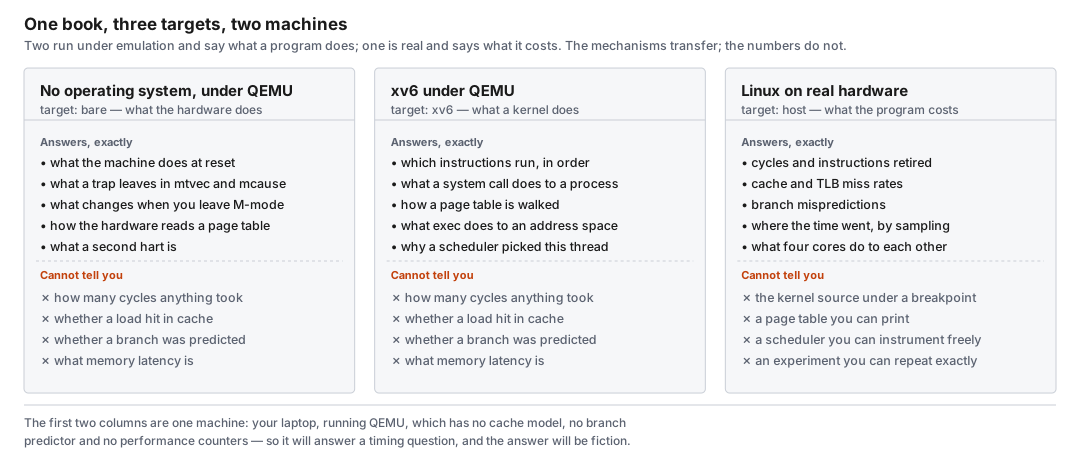
The division of labour. Every chapter declares which target it uses, and every figure records which one produced it.
The three are bare (a RISC-V processor — RISC-V is an open processor design — emulated by
QEMU on your own computer, with no kernel on it at all), xv6 (the MIT teaching kernel, running on
the same emulator), and host (a real Linux machine, a Raspberry Pi 5 by default);
ch00 sets them up and says what each can and cannot answer. That is
three targets on two machines: the first two are both QEMU on the computer you are reading
this on, and need one cross-compiler between them — a compiler that runs on your machine and
produces code for a different kind of processor. Only the third has to be real.
Part III works on both sides of the split, and
ch12 is where it crosses.
The split is not a compromise. QEMU will happily answer a question about nanoseconds and the answer will be meaningless, because it models no cache, no branch predictor and no pipeline. Watching a program in a debugger tells you what it does. Only real hardware tells you what it costs. ch23 puts the same program through both and makes the gap concrete.
The two emulated targets are RISC-V and the board is ARM, because the kernel small enough to read is a RISC-V kernel, and the hardware whose performance counters actually work — the processor’s own tally of what it did, which is what every cost in this book is read from — is an ARM one. Appendix H has the evidence.
That costs you one thing: you read disassembly in two instruction sets rather than one. Five chapters read it as AArch64, ARM’s 64-bit instruction set — ch26, ch27, ch29, ch30 and ch31 — and five read it as RISC-V, in Parts I and III. ch02 shows one small function both ways before either matters, and Appendix F translates between them.
It also buys something. Two chapters are about how one processor core’s writes to memory become visible to another — ch20 on RISC-V and ch28 on ARM — and a reader shown only one of them would reasonably conclude that is how it works everywhere. Shown two, you learn which parts are that design’s and which are the idea.
One argument, not two tutorials
Part V is not a second book. It is Part IV’s chapters asked again as questions about time. Every chapter in it names the earlier chapter whose cost it measures, in its own header:
| When Part V asks | You already learned the mechanism in |
|---|---|
| ch25 — where is the data, and what does each step outward cost? | ch13 layout and alignment, ch17 address translation |
| ch26 — what did that cost? | ch14 what the compiler emitted |
| ch27 — what is the core doing between fetch and finish? | ch14 the instructions themselves |
| ch28 — what do four cores cost each other? | ch20 locks, fences and ordering |
| ch29 — what does Linux charge for this? | ch16 traps, ch18 faults, ch21 switches |
So you never arrive at a Part V chapter cold. You arrive knowing the mechanism completely and needing only the price — a better position than either half could put you in alone, and the reason the book is arranged this way rather than as theory followed by benchmarks.
Three Part V chapters have no counterpart, deliberately: ch24 teaches measurement itself, ch30 is about the whole machine rather than any one mechanism, and ch31 concerns hardware Part IV never had reason to describe.
How the numbers work
The chapters whose reading depends on something specific about the reference machine say so in their own headers rather than letting you discover it two hundred pages in.
What you will need
A laptop for ch00 and for Parts I to IV — everything there runs under emulation, free. A small Linux machine with working performance counters for ch01 and Part V; a Raspberry Pi 5 is the reference, and one you already own may well do — Appendix H says exactly what it has to be able to do and how to check. Twenty-two chapters sit between needing the first and needing the second.
And the book’s repository. Every program a chapter shows, every problem it sets and every result behind a figure is a file in it, and the book is meant to be read here and worked through in a checkout — ch00 starts by cloning it.
The book does not tell you which kernel to run. Whether a machine’s performance counters work is a property of its whole configuration — silicon, device tree, kernel, firmware — rather than of the board, and the reference board’s own counters went missing for a kernel release. So every figure records the image and kernel that produced it, and ch00 hands you a script that asks your machine instead of a version number to match.
- Gregg, B. (2020). Systems Performance: Enterprise and the Cloud (2nd ed.). Addison-Wesley. https://www.brendangregg.com/systems-performance-2nd-edition-book.html
- Cox, R., Kaashoek, M. F., & Morris, R. (n.d.). xv6: a simple, Unix-like teaching operating system. MIT. https://pdos.csail.mit.edu/6.1810/