Optional workshopsOptional workshops · 14 min
Design an open box
Combine algebra, constrained optimisation and numerical plotting in a checked design.
Maths refresher: A volume from changing dimensions
Box volume is height times length times width. Folding a cut of size x removes x from both ends of each original sheet dimension.
The width becomes zero at , so that endpoint is not a useful box. A stationary point beyond 4 cannot be a feasible design.
Cutting equal squares from the corners of a rectangular sheet and folding the sides produces an ideal open box. Its volume depends on the cut size. The sheet dimensions below are invented teaching inputs in centimetres, and material thickness is ignored.
Derive the volume, state the permitted cut interval, find stationary candidates and compare the feasible interior with limiting boundaries. An unconstrained algebraic root outside the interval is not a possible cut. Keep the exact optimum before approximating it for a practical reading.
Plot the volume over the full feasible interval as an interpretation aid, while retaining the derivative and boundary checks as mathematical evidence. Extend the report with tolerances, thickness, manufacturing constraints or cost only when the model states how those affect the objective.
Can the larger algebraic stationary root be used as a cut even if it exceeds the sheet’s half-width?
Write a prediction (optional)
Integrated design with invented dimensions
Select Run Python with the code unchanged.
Your saved draft is open. To use the published code, select Restore example in Tools. Use Recover draft to bring back your code.
Tools
About Python
Python and the course packages can load while you read. Each run starts with fresh user variables; imported modules stay loaded. Stop replaces the worker. Runtime details ↗
Ctrl+Enter or ⌘+Enter runs Python.
Execution error
Technical error details
Your result
Python text output
Compare with the worked example
Executed from the published Python during the site build. Your own run appears above. Build environment ↗
Worked text output
Volume in cm cubed: x*(8 - 2*x)*(12 - 2*x)
Feasible cut interval, cm: Interval.open(0, 4)
All stationary candidates: [10/3 - 2*sqrt(7)/3, 2*sqrt(7)/3 + 10/3]
Best cut, exact cm: 10/3 - 2*sqrt(7)/3
Best cut, approximate cm: 1.5694991
Second derivative at best: -16*sqrt(7)
Limiting boundary volumes: [0, 0]
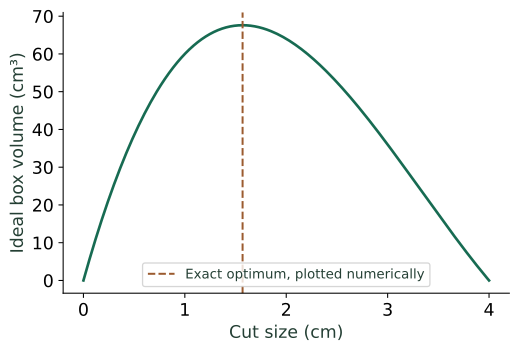
Read the starter result
Feasible cut interval, cm excludes the degenerate endpoints shown in the plot. Use Best cut, exact cm and Limiting boundary volumes to compare the interior optimum with the boundary limits.
Edit and compare
Replace length,width = 12,8 with length,width = 15,9. The code derives the open domain, limiting volumes and plot range from the shorter side. Select Run Python. Compare Feasible cut interval, cm, Best cut, exact cm and Limiting boundary volumes.
Scope. The sheet is invented and ideal: thickness, fold radius, tolerances, waste and structural strength are omitted.
Try a fresh case
A manufacturing rule requires cuts in half-centimetre increments. What must change?
Need a hint?
Hint 1
List the cuts the manufacturing rule permits.
Hint 2
Evaluate their actual objective values.
Write your investigation report
Record the question, mathematical assumptions and proposed checks before interpreting the result. After execution, add the derivation, numerical comparison and limits. The export includes the last successful run.