Optional workshopsOptional workshops · 14 min
Plan a circuit threshold time
Derive a threshold-crossing formula from an ideal response and check it by substitution.
Maths refresher: A threshold solves an equation
A crossing time is an input t for which the response reaches a specified level. It must lie in the permitted time domain.
Because , it cancels from this half-voltage equation. Doubling R with C fixed doubles the ideal crossing time.
An ideal RC circuit provides a simple model where symbolic derivation, solving and numerical plotting reinforce one another. Starting with zero capacitor voltage, its charging response approaches a constant input V on time scale .
Solve for the time to reach half the final voltage, using positive parameters and a nonnegative physical time. Substitute the derived time into the original response to verify the threshold. The symbolic result shows which parameter combinations influence the timing and which cancel.
The selected resistance, capacitance and voltage are invented demonstration inputs. Component tolerances would create uncertainty in the crossing time even when the algebra is exact. Use the report to distinguish the ideal result, the numerical illustration and any evidence needed for a practical timing specification.
Will doubling V alone change the time to reach one half of that same V in the ideal model?
Write a prediction (optional)
Integrated ideal circuit with invented components
Select Run Python with the code unchanged.
Your saved draft is open. To use the published code, select Restore example in Tools. Use Recover draft to bring back your code.
Tools
About Python
Python and the course packages can load while you read. Each run starts with fresh user variables; imported modules stay loaded. Stop replaces the worker. Runtime details ↗
Ctrl+Enter or ⌘+Enter runs Python.
Execution error
Technical error details
Your result
Python text output
Compare with the worked example
Executed from the published Python during the site build. Your own run appears above. Build environment ↗
Worked text output
Charging response: V*(1 - exp(-t/(C*R)))
Threshold voltage: V/2
Threshold time: C*R*log(2)
Conditions for a positive finite crossing: True
Threshold residual: 0
Illustrative crossing, seconds: 0.069314718
Sensitivity to R: C*log(2)
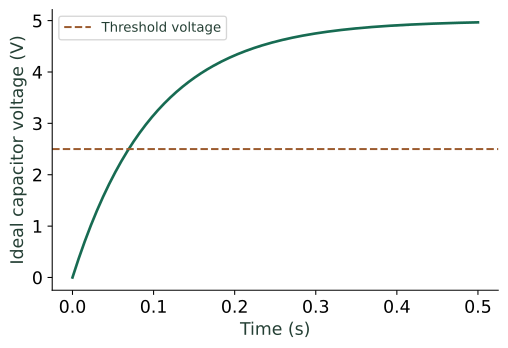
Read the starter result
For the starter threshold V/2, V cancels from Threshold time. The calculation requires the threshold to be above zero and below the final voltage. The exact residual checks the crossing equation in that range.
Edit and compare
Replace threshold = V/2 with threshold = sp.Integer(2) for a fixed two-volt threshold. Select Run Python. Compare Threshold time and Conditions for a positive finite crossing with the first run. What must the final voltage exceed? Check Threshold residual and the updated horizontal line.
Scope. The ideal response and invented components omit tolerances, parasitics, load effects and hardware validation.
Try a fresh case
For an absolute threshold above the final voltage V, what does the ideal monotone response imply?
Need a hint?
Hint 1
Inspect the response’s initial value and long-time limit.
Hint 2
Compare the threshold with that reachable interval.
Write your investigation report
Record the question, mathematical assumptions and proposed checks before interpreting the result. After execution, add the derivation, numerical comparison and limits. The export includes the last successful run.