How neural networks turn raw scores into probabilities for classification
This post is a standalone explanation of softmax that you can reference from any classifier walkthrough, whether it is an image model, a text model, or a simple toy example.
Where Does Softmax Fit?
Before diving into how softmax works, let’s see where it sits in a classification pipeline. Here’s a simple edge detection network:
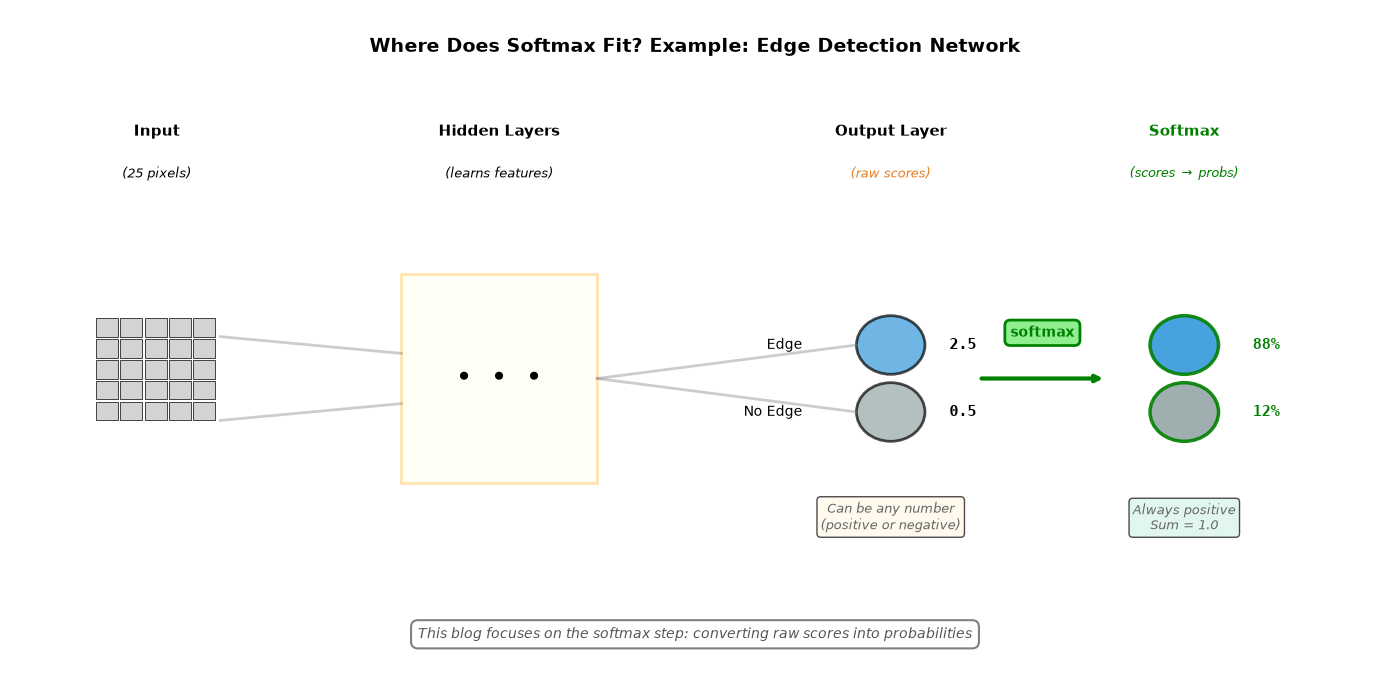
The key point: Softmax operates on the final layer’s raw scores, converting them into probabilities that sum to 1. The rest of this post explains how softmax works, regardless of the network architecture.
From Scores to Probabilities - Softmax
In a classification model, the final layer produces scores (also called logits) — higher means the model favors that class more. But for classification, we need probabilities: “What’s the chance this is an edge?”
Suppose our model has two output neurons (one for “Edge”, one for “No Edge”), each producing a score. So we have a vector of scores . These raw scores can be any number — positive, negative, or zero.
📘 Terminology: Logits
The raw scores before softmax are called logits. You’ll see this term everywhere in machine learning.
Logits can be any real number (−∞ to +∞)
Softmax converts logits → probabilities (0 to 1, summing to 1)
Softmax converts this score vector into a probability vector where:
All values are positive
They sum to 1.0
The Intuition: It’s Just a Ratio
At its core, softmax answers: “What fraction of the total is each score?”
If we only had positive scores, we could just divide by the sum:
Where:
is the class index (e.g., for “Edge”, for “No Edge”)
is the raw score for class
is the resulting probability for class
The sum is over all classes
For example, scores would give and .
The problem: Scores can be negative or zero, which breaks this.
The solution: First apply to make everything positive, then take the ratio.
The Formula
The exponential also amplifies differences — a score of 5 vs 3 becomes vs (148 vs 20), making the network more confident.
The visualization below shows the 3-step process:
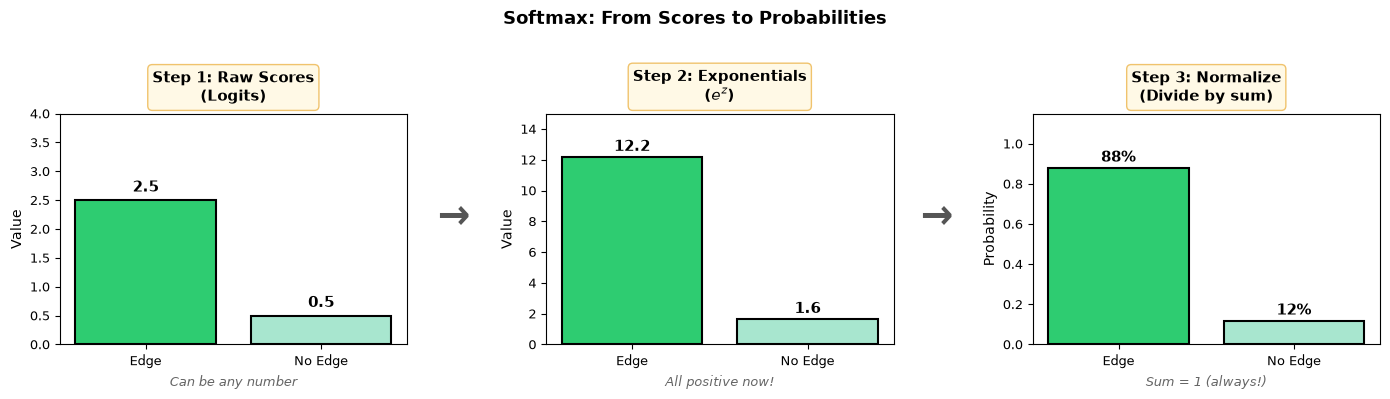
Implementation:
# z is a vector of scores (logits) for all classes
z = np.array([2.5, 0.5])            # e.g., [Edge score, No-Edge score]

exp_z = np.exp(z)                   # exponentiate each element
p = exp_z / np.sum(exp_z)           # normalize → probability vector

print(f"Logits z: {z}")             # [2.5, 0.5]
print(f"exp(z):   {exp_z}")         # [12.18, 1.65]
print(f"Probs p:  {p}")             # [0.88, 0.12]
This computes all values at once: p[j] =
Note on Numerical Stability: In practice, we subtract the max score before exponentiating to prevent overflow. This is safe because the constants cancel in the ratio:
So we can choose without changing the result:
exp_z = np.exp(z - np.max(z))        # stable: prevents overflow
p = exp_z / np.sum(exp_z)            # same result as before
Multi-Class Example
Softmax works for any number of classes, not just two. Here’s a 3-class example:
# Multi-class classification: Cat, Dog, Bird
z = np.array([3.2, 1.3, 0.2])           # scores for each class

exp_z = np.exp(z - np.max(z))           # stable computation
p = exp_z / np.sum(exp_z)               # normalize

print(f"Logits:  {z}")                  # [3.2, 1.3, 0.2]
print(f"Probs:   {p}")                  # [0.70, 0.24, 0.06]
print(f"Sum:     {p.sum():.1f}")        # 1.0

# Interpretation: 70% Cat, 24% Dog, 6% Bird
The highest score (3.2 for Cat) gets the highest probability (70%), but the other classes still have non-zero probabilities. This is useful for understanding model confidence and handling uncertain predictions.
Common Pitfalls
⚠️ Things to Watch Out For
1. Don’t apply softmax to already-normalized outputs
If your network already outputs probabilities (sum to 1), softmax is redundant
Example: Don’t apply softmax after another softmax layer
2. Softmax is for classification, not regression
Use softmax when predicting categories (cat, dog, bird)
Don’t use it for continuous values (e.g., predicting temperature or price)
For regression, use raw outputs or other activation functions
3. Softmax is differentiable
This is crucial for training neural networks with backpropagation
The gradient flows through softmax during training
You typically use cross-entropy loss with softmax for classification
4. Temperature scaling
Dividing logits by temperature T before softmax affects confidence:
T > 1: Less confident, more uniform probabilities
T < 1: More confident, sharper probabilities
Default T = 1 (standard softmax)
Summary
Softmax converts raw scores (logits) into probabilities:
Input: Raw scores that can be any number
Output: Probabilities between 0 and 1 that sum to 1
Method: Exponentiate to make positive, then normalize
Key formula:
This makes softmax the standard final layer activation for multi-class classification in neural networks.